


"How often should we measure well-being or engagement?" This is the question I get most often. And honestly, it is a great one.
It highlights the growing focus on people's well-being, and the importance of having the right tools to measure, track, and improve it.
Let me share what we have learned over the years.
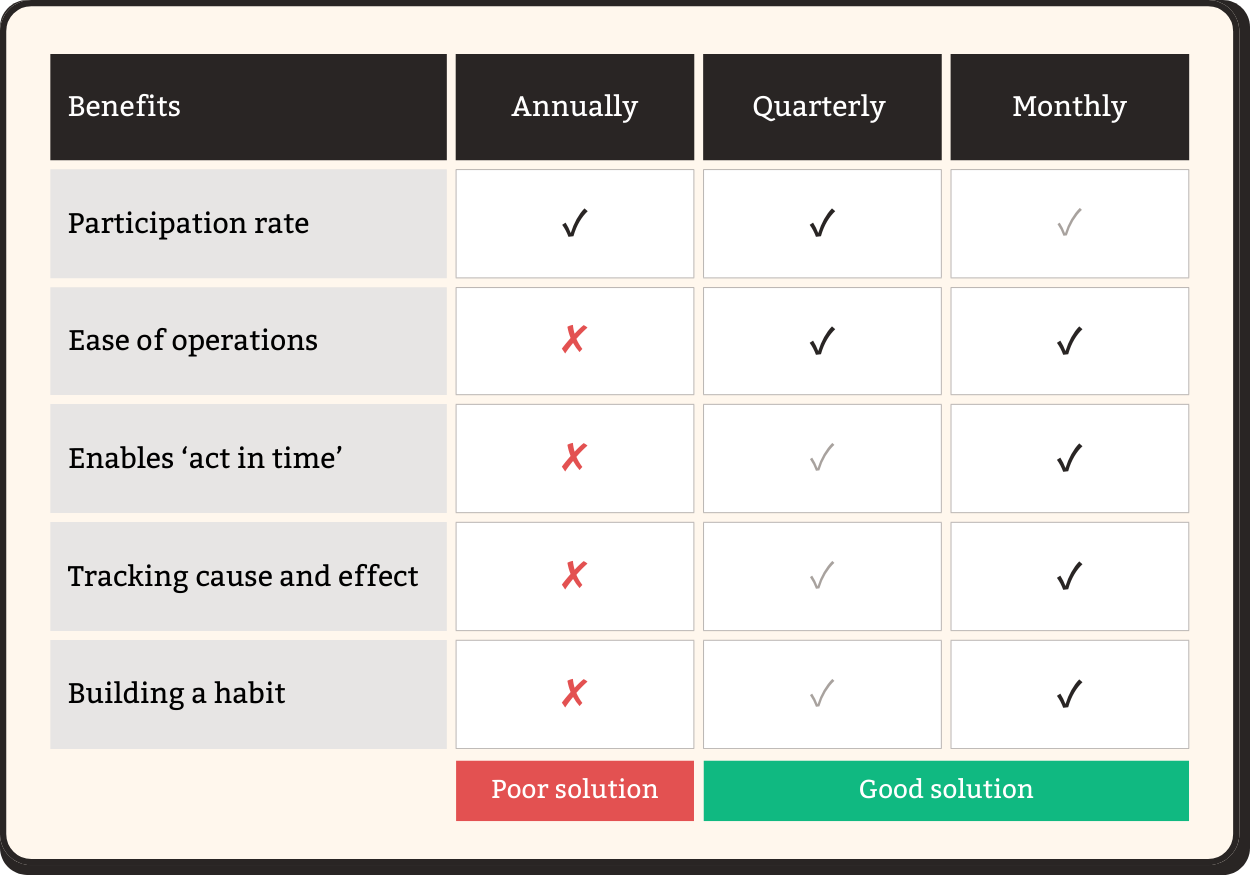
Pros and cons of different measurement cadences.
What does the law say?
If your organization needs to comply with ESG (Environmental, Social, and Governance) regulations, you are required to measure at least once a year. That is the baseline. But is annual measurement really enough to understand and improve what people experience at work?
Not always.
You can measure more frequently, even monthly if you choose, but there are trade-offs depending on how often you collect the data. Let's break it down.
Key factors to consider
There is no one-size-fits-all answer, but these five variables can guide your decision.
1. Participation rate
Participation is the foundation of any effective survey. Without solid response rates, your data cannot tell a clear story.
Annual and quarterly surveys tend to achieve higher participation rates because people are not overwhelmed by survey fatigue. The good news is that many companies successfully maintain high participation rates even with monthly surveys. The key is simplicity and consistency in how you run them.
2. Ease of operations
Annual surveys are typically a heavy lift. They are often highly manual, custom-designed, and packed with reporting requirements. For many organizations, that makes the process time-intensive and clunky.
Quarterly and monthly surveys, by contrast, rely more on automation. When the process is streamlined, the effort shifts from setup to taking meaningful action on the insights.
3. Acting in time
Annual surveys leave you flying blind for 11 months. Think about that for a moment. What happens when you only uncover a serious engagement issue, or an uptick in stress, months after it has already impacted your people?
More frequent measurement allows you to respond proactively. Whether it is a quarterly pulse survey or a monthly check-in, the sooner you know, the sooner you can act.
4. Tracking cause and effect
One of the biggest challenges with annual surveys is linking the results to specific causes. Over a year, so many things can impact well-being and engagement: leadership changes, major projects, even global events such as a pandemic.
Measuring more frequently narrows the window, making it easier to connect the dots between initiatives and outcomes. This clarity helps you track ROI, refine your strategy, and improve results faster.
5. Building a habit
When data is reviewed only once a year, it often feels foreign to leaders and teams. It is easy to forget what we measured, what the data showed, or even why it mattered in the first place.
Regular measurement, on the other hand, creates a habit. Leaders become accustomed to using the data, discussing it with their teams, and turning insights into tangible actions. Over time, this rhythm embeds the importance of well-being and engagement into the culture.
Which frequency is right for you?
The answer depends on your goals, your resources, and your culture.
To make this easier, here is a quick guide to the pros and cons of different cadences:
- Annual measurement. Good for ESG compliance and capturing a big-picture view. Not ideal for tracking trends or acting quickly.
- Quarterly measurement. A balanced approach that allows for better responsiveness without overwhelming your teams.
- Monthly measurement. Best for organizations that want to build habits, track cause and effect, and stay proactive. Requires more discipline to maintain participation and focus.
Final thoughts
When it comes to well-being and engagement, more frequent measurement means more opportunities to listen, learn, and improve. Annual surveys may check a compliance box, but they often miss the nuance and timeliness needed to make a real impact.
If you are considering a shift to more frequent surveys, start small. Experiment with quarterly or monthly measurements. See what works for your people and the rhythm of your organization.
Remember, the ultimate goal isn't just to measure. It is to take meaningful action on what you learn.