


What recommendations do People and Culture experts have on the frequency of measuring engagement, the technology to use today, and the primary causes of poor retention? We asked 19 of them. Here is what they said.
Context
In a recent survey, we asked a roundtable of People and Culture experts from various industries and company sizes a few questions about retention.
First, we wanted to look into how well People and Culture teams are doing on retention, whether they track it, and how often.
Second, we looked at how they use technology today, how they expect this to change, and the biggest challenges they face with technology in People and Culture today.
Finally, we asked them about the primary causes of poor retention, the best advice they have given or used, and what they consider a good retention goal.
Read on to learn how you can improve your retention based on what the experts told us.
1. Measure engagement frequently
Our roundtable showed that the experts believe they are doing reasonably well on retention. They scored themselves 3.95 out of 5 on average. This aligns with the question of whether they actually track their retention rate. 74% of respondents said they do.
What is interesting is that they also put real emphasis on the frequency of measuring engagement. Only two respondents said they measure yearly or less. More than half said they measure quarterly or monthly. So one element of having success in retaining your people is measuring relatively often.
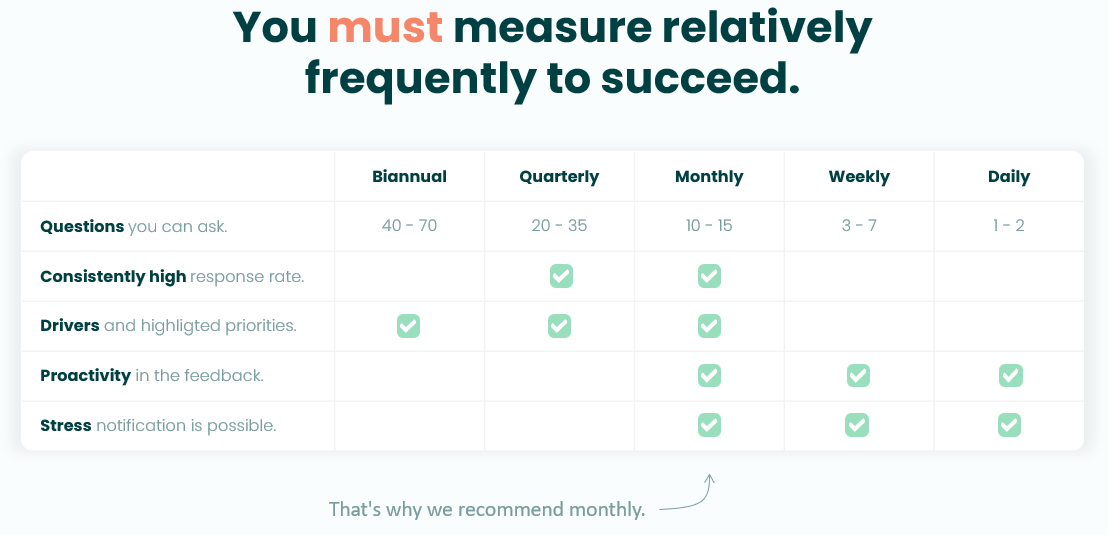
How often P&C experts measure employee engagement.
If you measure twice a year or less, you compromise on a consistent response rate, which means data quality suffers.
That is also true if you measure more often than weekly. There you risk overwhelming people with surveys and pulling them away from their day-to-day work.
You will find it difficult to be proactive in your leadership when data arrives less often than monthly. The data will simply be out of date by the time you see it. That is a shame when you have invested in valuable insights into well-being.
Catching stress signals in time at low frequencies is equally hard. That means you have a higher risk of people leaving due to stress. You already know how much you invest in your people, and how costly it is to lose talent. So to improve your retention, you must measure your people data relatively often.
2. Use a People Analytics software today
In the survey, the People and Culture experts scored themselves at 3.16 out of 5 on average when asked how good they are at using technology to support them. Going forward, they expect to significantly improve. 12 months from now, they expect to score an average of 4.16 out of 5. So they expect that investing in new technologies for measuring well-being, stress and eNPS will significantly improve their retention rate.
The survey also showed that the experts think the bottom three challenges with technology in People and Culture today are:
- "The technology doesn't solve our needs." (79%)
- "The technologies are not good enough." (68%)
- "The technology is moving too fast." (63%)
So there is no major issue with the solutions available today. Where, then, does the challenge lie?
79% of People and Culture experts named "the technology selection process" as a top challenge, and 68% named "the rollout to employees and leaders" as a top challenge.
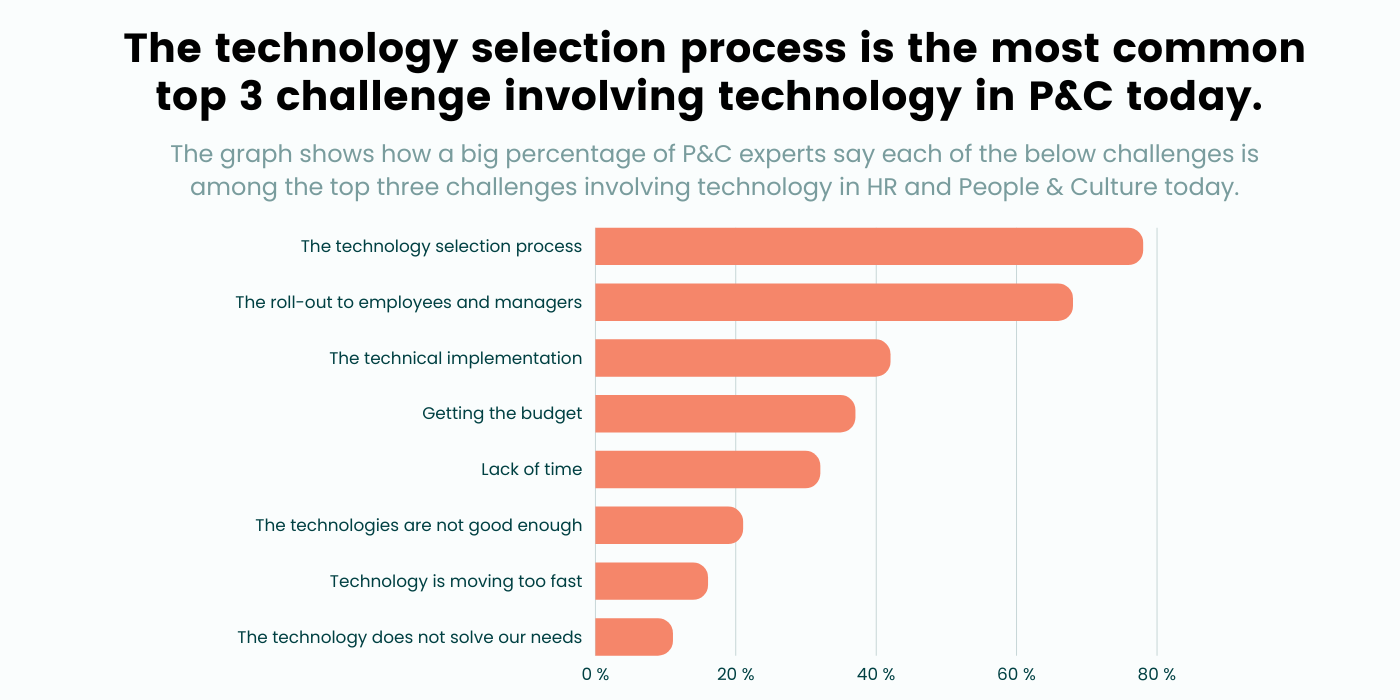
Top challenges involving technology in HR and People & Culture today.
So how do you reach the improvement you expect 12 months from now? You must scope the software solutions on the market and be critical about whether the vendor will ensure a meaningful implementation, one that actually gives you the chance to act on the value created with the data.
3. Poor leadership causes poor retention
When we asked about the primary causes of poor retention, about half of the experts pointed to poor leadership. Other named causes included a lack of focus on culture, lack of development and recognition, lack of transparency in the organization, and bad onboarding.
Figen Cayan, Chief of Staff at A.P. Moller - Maersk, says the primary cause of poor retention is "Not being aware of the root causes for employees leaving, meaning not tracking onboarding and the well-being of the employees."
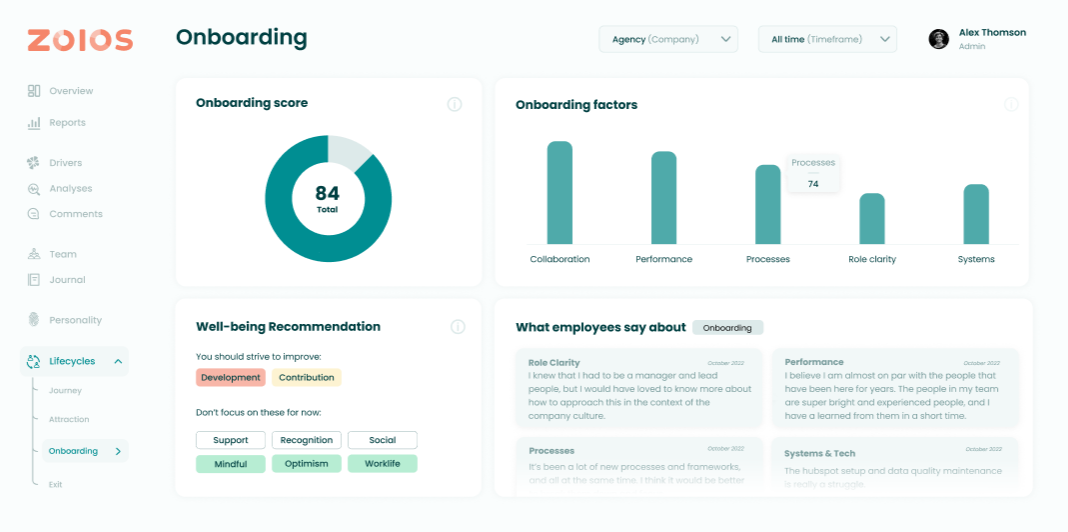
An example of an onboarding analysis in Zoios.
Using a People Analytics tool such as Zoios gives the companies of tomorrow a way to equip their leaders to be heroes of the workplace. Through Zoios, leaders can see the root causes of poor well-being for each of the 8 drivers of well-being, segmented by department, seniority, generation, location and more.
You must help your leaders acquire the means to be great leaders, so they can ensure a great work environment in terms of well-being and stress.
We also asked the experts what the best advice they had heard for retaining people was. The answer was clear: put people first, listen to them, and build a strong relationship with them.
Anna Gullstrand, Acting CEO and Chief People and Culture Officer at Mentimeter, says that the best advice on retaining people is to "build a collaborative culture where people are and feel included. Create commitment to reach a common purpose, together."
To succeed in building a collaborative culture, leaders must be well-equipped to act on the people data insights. Beyond the software, Zoios offers leader workshops designed to work with the people data insights from the platform. This significantly improves the success rate of creating alignment toward a common purpose, together.
Finally, we wanted to understand what the experts think a good retention goal looks like. The answers were clear: happy people who feel engaged, a sense of growth, and a sense of belonging. Some pointed out that a specific target is between 5 and 10% turnover.
A part of building a collaborative culture is looking at the employee journey as a whole.
Summary
The People and Culture experts pointed out that measuring engagement frequently is advantageous. It gives you a consistent response rate, lets you act on feedback proactively, and helps you catch stress signals before it is too late.
They also expect that investing in a People Analytics tool such as Zoios for measuring well-being, stress and eNPS will significantly improve retention.
Finally, they highlighted that the primary causes of poor retention are poor leadership and a lack of focus on culture, development and recognition. You must help your leaders acquire the means to be great leaders, so they can ensure a great work environment in terms of well-being and stress.